- New!
- Band
- Percussion
- Orchestra
- Brass Band
- Jazz
- Chamber
- Voice
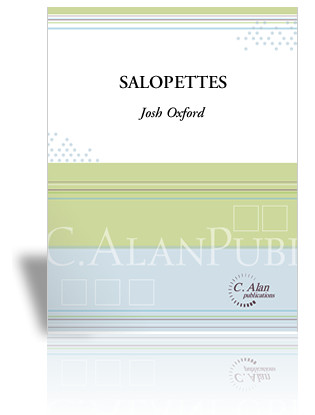


Salopettes (Flute/Marimba Duet)
Genre: Duet for Flute & Marimba
# of Players: 2
Level: Medium Difficult | Duration: 7:30
Publisher: C. Alan Publications | Copyright: 2017
Download mp3 | Click on images to left for score sample

Rating:
Price:
$25.00
Item #:
24320
-
Notes & Instrumentation
Challnged by famed marimbist Gordon Stout to compose a work for flute & marimba, Josh Oxford impressively cranked out Salopettes in a matter of days. It is an impressive display for both players and extremely musically satisfying for the audience.
Genre: Duet for Flute & Marimba | # of Players: 2
Level: Medium Difficult | Duration: 7:30
Instrumentation
Flute
5-octave Marimba
Program Notes
After hanging out with marimbist Gordon Stout after a concert, he challenged me to write a piece for flute and marimba. I wrote this piece in the next few days and sent it to him. Salopettes was premiered by Maya Holmes and Chris Demetriou.-J.O.
-
Product Reviews
-
Percussive Notes New Literature Review
“Salopettes!” is a chamber work that came about as a challenge to the composer from Gordon Stout to write a piece for flute and marimba. The most striking thing about the piece is the skillful use of odd and mixed meters throughout. In addition, Josh Oxford uses odd note groupings such as 3’s, 5’s, and 7’s to create interesting effects. The piece begins (quarter note = 100) in 7/16 and 5/16, with groups of 2’s and 3’s setting up a very compelling, disjointed feel.
The musical vocabulary is neo-tonal, but very lyrical. Most of the time, both instruments are quite active together, and at other times, the flute plays longer notes over the continued complex rhythms from the marimba. The flutist is asked to sing and play simultaneously at several points. Eighth-note triplets moving to eighthnote quintuplets brings the piece to a slower tempo (quarter note = 90 and later quarter note = 60) for a middle section. Much of this is in 4/4 with some 7/16, but now the mood is much more lyrical and relaxed. Oxford brings this part of the piece to a close using odd note groupings of greater length, giving the impression of slowing the tempo. After a caesura, things take off again at Tempo I, with a further development of the opening material. The piece closes after a driving ostinato in the marimba followed by unison rhythms creating a strong finish.
This is a well-written composition that will require great rhythmic control by both players. The odd meters sound natural, and audiences will find the work exciting.
Tom Morgan
Percussive Notes
Vol. 57, No. 3, July 2019 Tom Morgan on Jul 15th 2022
-