- New!
- Band
- Percussion
- Orchestra
- Brass Band
- Jazz
- Chamber
- Voice


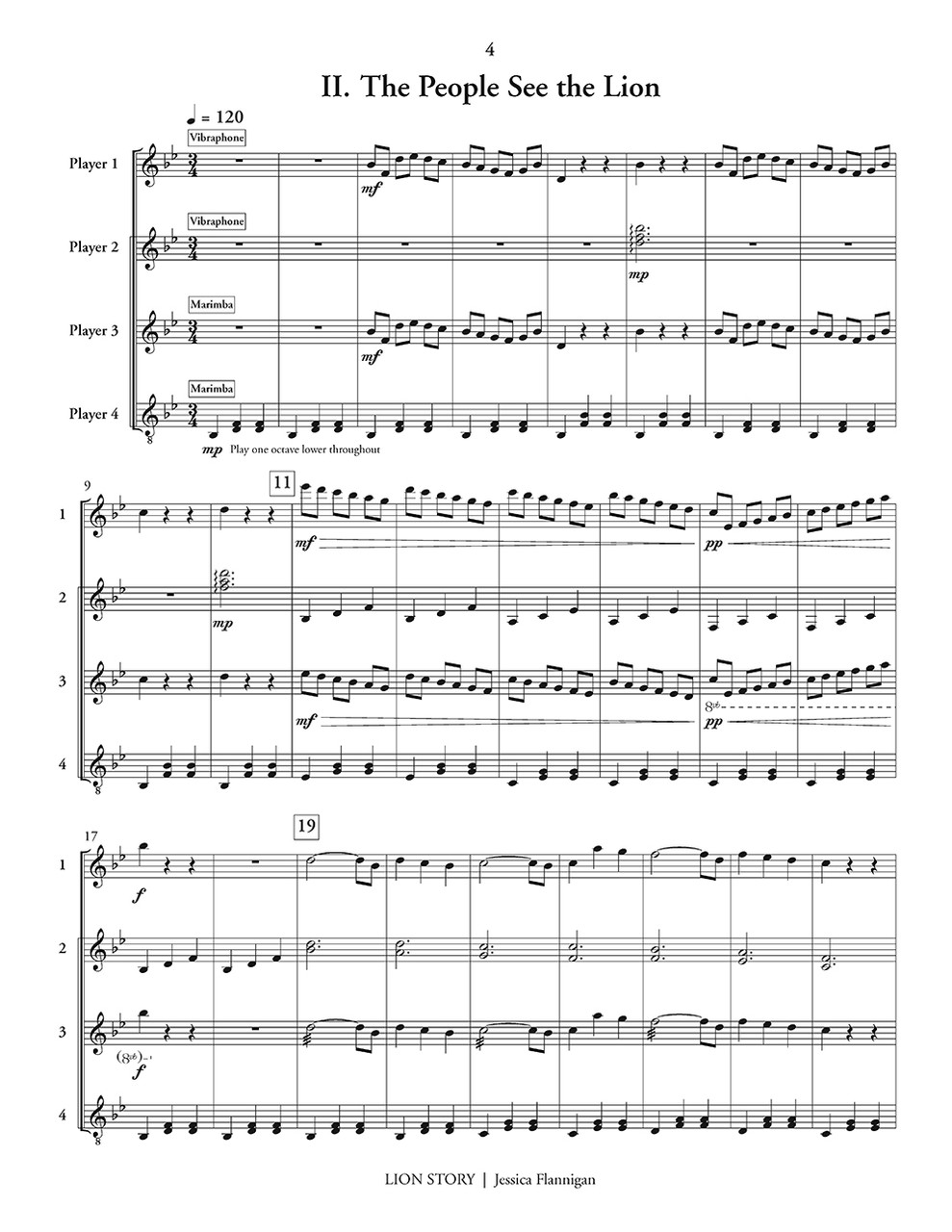

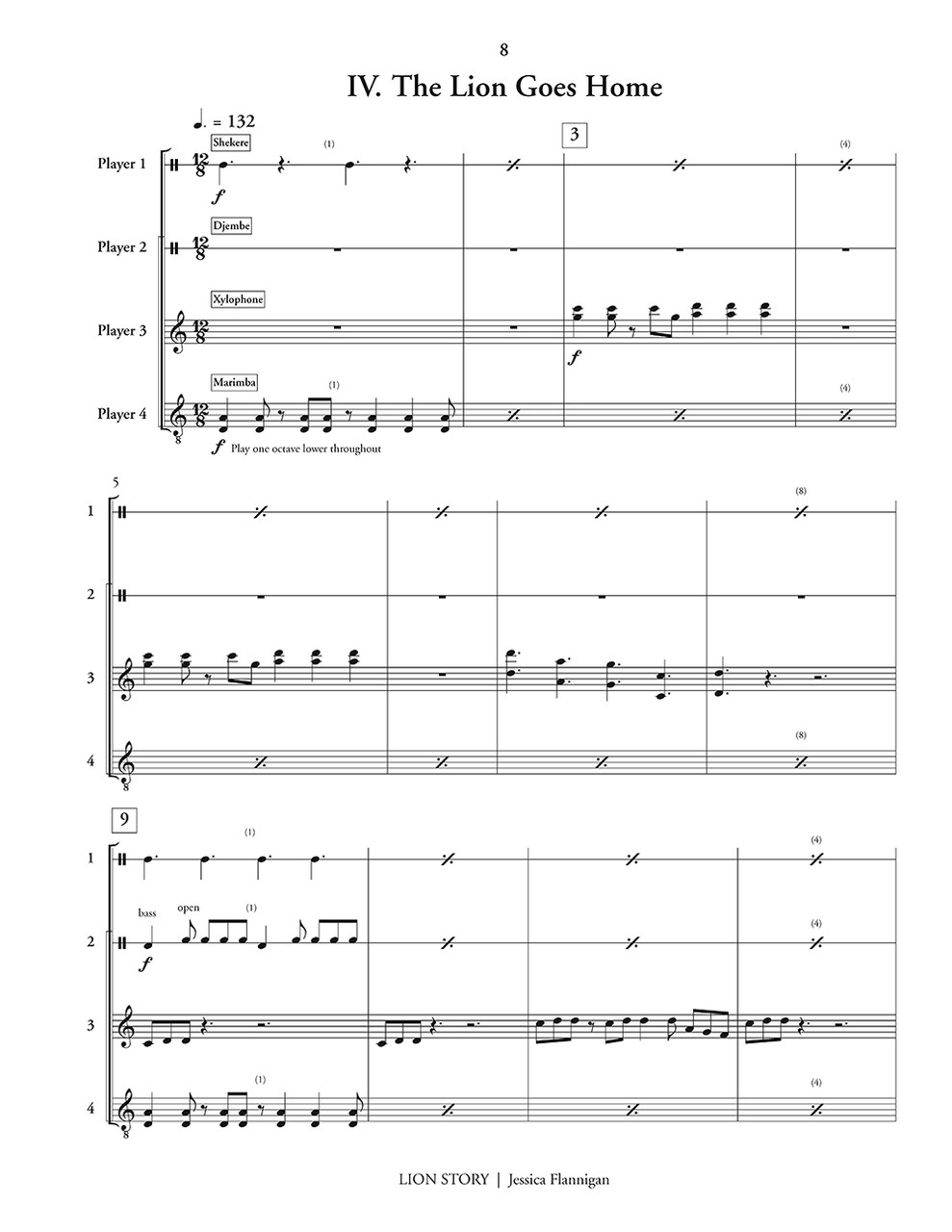
Lion Story - Jessica Flannigan [DIGITAL]
Genre: Percussion Ensemble
# of Players: 4
Level: Medium | Duration: 5:20 total
Publisher: C. Alan Publications | Copyright: 2020
Download mp3 | Click on images to left for score sample

Rating:
Price:
$32.00
Item #:
27010D
-
Notes & Instrumentation
Lion Story is a quartet in four movements for young percussion ensemble. Each movement features a solo part on melody with ostinato accompaniment perfect for a middle school or beginning percussion ensemble.
Genre: Percussion Ensemble | # of Players: 4
Level: Medium | Duration: 5:20 total
Instrumentation
Player 1: Xylophone, Vibraphone, Glockenspiel, Shekere
Player 2: 4.3-octave Marimba (may be shared with Player 4), Vibraphone, Bass Drum, Djembe
Player 3: 4-octave Marimba, Xylophone
Player 4 (4.3-octave Marimba [may be shared with Player 2]
Program Notes
When my son, Branden, was 5 years old he and I would go down to our basement and play marimba together. I would give him an ostinato accompaniment while I played a melody over the top, and he was always excited to name each song, the first being 'The Lion Goes to the Zoo.' Eventually I put them all together and filled out each movement with two more parts to give some depth to the piece. Branden finished naming each movement, and now we have our Lion Story.
- J.F. -
Product Reviews
-
Percussive Notes New Literature Review
“Lion Story” is a charming work in four short movements, lasting just over five minutes. Each was developed while Jessica Flannigan was improvising with her 5-year-old son, Branden, who also provided the titles. Pedagogically, this piece presents mature musical content scored for less advanced players, requiring them to perform on a variety of instruments. The first movement, “The Lion Goes to the Zoo,” features alternating statements between the xylophone and upper marimba part, while the lower marimba parts provide chordal and eighthnote accompaniment, reminiscent at times of Chick Corea’s “Children’s Songs.” The second, “The People See the Lion,” is mellow and dreamy, scored for two vibraphones and two marimbas. Here, one of the vibraphones and one of the marimbas are in unison throughout, with the other vibraphone providing occasional chordal figures against an underlying quarter-note bassline in the bottom marimba part. This is followed by “The Lion Sleeps” — a slow and shimmering movement that perhaps invokes the spirit of Camille SaintSaëns with its use of glockenspiel, static marimba tremolos, and soft, ringing notes on the bass drum. The final movement, “The Lion Goes Home,” uses African influences to signify the lion leaving the captivity of the zoo and returning to its homeland. These are seen with use of a 12/8 bell pattern in the marimba and hocketed eighth-note rhythms in the xylophone, djembe, and shekere.
All parts are written for two mallets, with a pretty even distribution of difficulty, although the Player 4 part is the most repetitive and simple. As Players 1 and 3 play the xylophone in different movements, careful placement of the instrument in the setup and allowing a few extra moments for transitions would make it possible to play the piece without two instruments. This is a delightful work appropriate for an intermediate high school to beginning college ensemble, or a more advanced group performing a children’s concert.
Jason Baker
Percussive Notes
Vol. 59, No. 5, October 2021 Jason Baker on Jun 30th 2022
-