- New!
- Band
- Percussion
- Orchestra
- Brass Band
- Jazz
- Chamber
- Voice
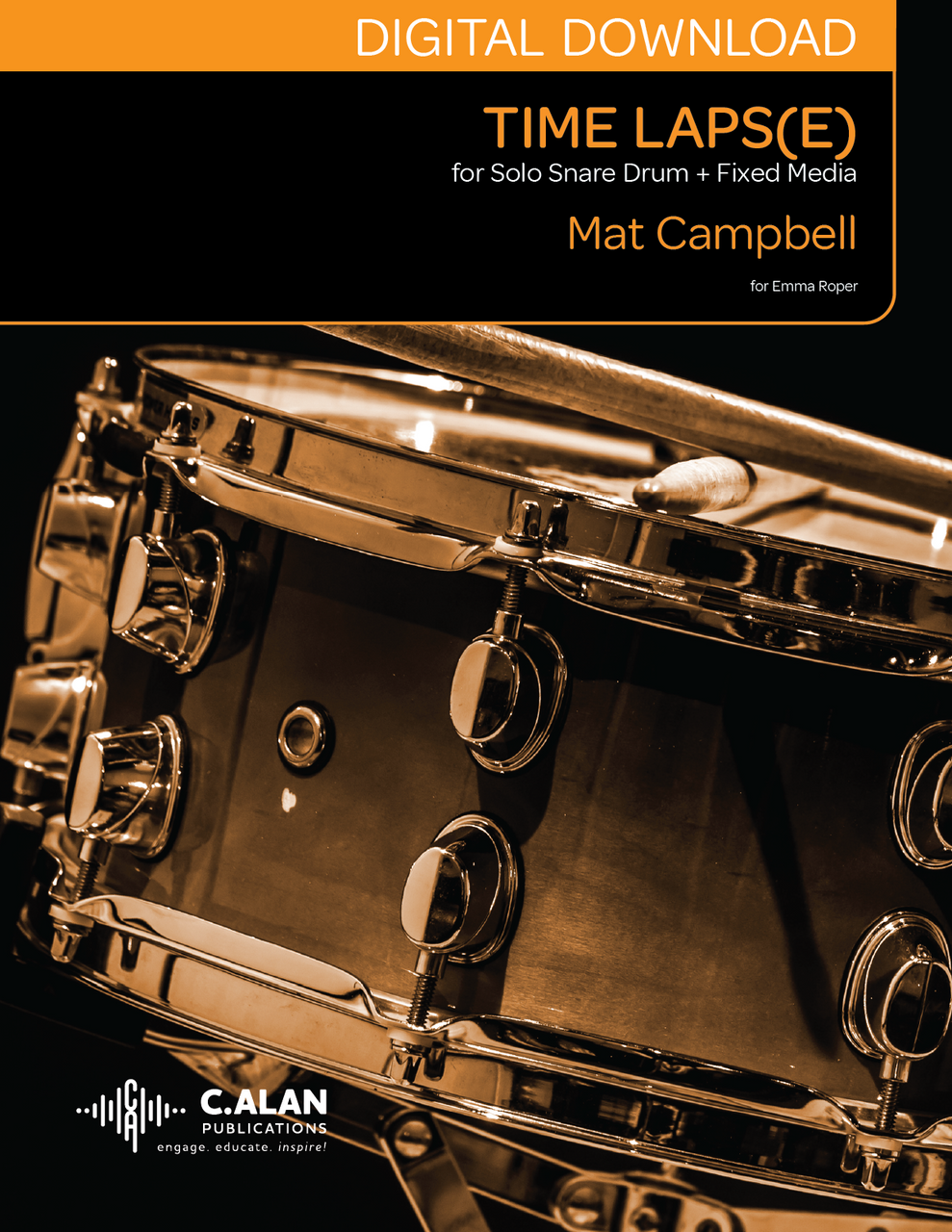


Time-Laps(e) - Mat Campbell [DIGITAL]
Genre: Snare Drum + Track
Series: N/A
# of Players: 1
Level: Medium Advanced | Duration: 4:25
Publisher: C. Alan Publications | Copyright: 2025
DOWNLOAD ELECTRONIC TRACK AND VIDEO

Price:
$18.00
Item #:
35660D
-
Notes & Instrumentation
Time Laps(e) explores the concept of phasing, where a melody or rhythm loops around itself. As layers drift apart and return to unison, the effect mirrors a runner lapping another on a track. This sense of circular motion and shifting alignment echoes the visual rhythm of a time-lapse, which inspired the piece’s title and structure.
Genre: Snare Drum + Track | # of Players: 1
Series: N/A
Level: Medium Advanced | Duration: 4:25
Instrumentation
Snare Drum (any type of the concert or marching variety) sticks, brushes
Fixed Media track (alone) or video (recommended)DOWNLOAD ELECTRONIC TRACK AND VIDEO
Program Notes
Time Laps(e) explores the concept of phasing, where a melody or rhythm loops around itself. As layers drift apart and return to unison, the effect mirrors a runner lapping another on a track. This sense of circular motion and shifting alignment echoes the visual rhythm of a time-lapse, which inspired the piece’s title and structure.The work condenses a wealth of material into four minutes while maintaining musical clarity. All ideas stem from a single motif, developed across four sections. Each section uses a different subdivision of the half note, decreasing rhythmic emphasis while increasing rhythmic density over time: eighth note triplets, quintuplets, straight eighths, and finally quarter note triplets. In result, the return of early material in the final section feels stretched and transformed.
Accompanying the music is a video of time-lapse footage, reinforcing the piece’s central metaphor. Together with the fixed media, the visual element deepens the illusion of time both suspended and steadily advancing. As rhythmic layers unfold and re-align, and the video compresses hours into seconds, the piece evokes a kind of temporal dissonance: where motion feels constant but meaningfully detached. The result is meditative yet elusive, capturing the quiet tension between stillness and progress, presence and impermanence all to ask one question: “What does time feel like when we stop measuring it?”
Time Laps(e) was commissioned in 2019 by my friend and fellow Oklahoma City University alum, Emma Roper.
-
Product Reviews