- New!
- Band
- Percussion
- Orchestra
- Brass Band
- Jazz
- Chamber
- Voice
The Shared Breath of the Earth (Solo Timpani) [DIGITAL]
Genre: Timpani
# of Players: 1
Level: Medium Difficult | Duration: 4:30
Publisher: C. Alan Publications | Copyright: 2019
Download mp3 | Click on images to left for score sample

Rating:
Price:
$18.00
Item #:
26050D
-
Notes & Instrumentation
the shared breath of the earth is a solo for melodic timpani, and a celebration of three characters of nature that live in urban settings. A true challenge for the timpanist, the extreme pedaling demands contrast the delicate music that lives within.
Genre: Timpani | # of Players: 1
Level: Medium Difficult | Duration: 4:30
Instrumentation
Solo Timpani (4 drums)
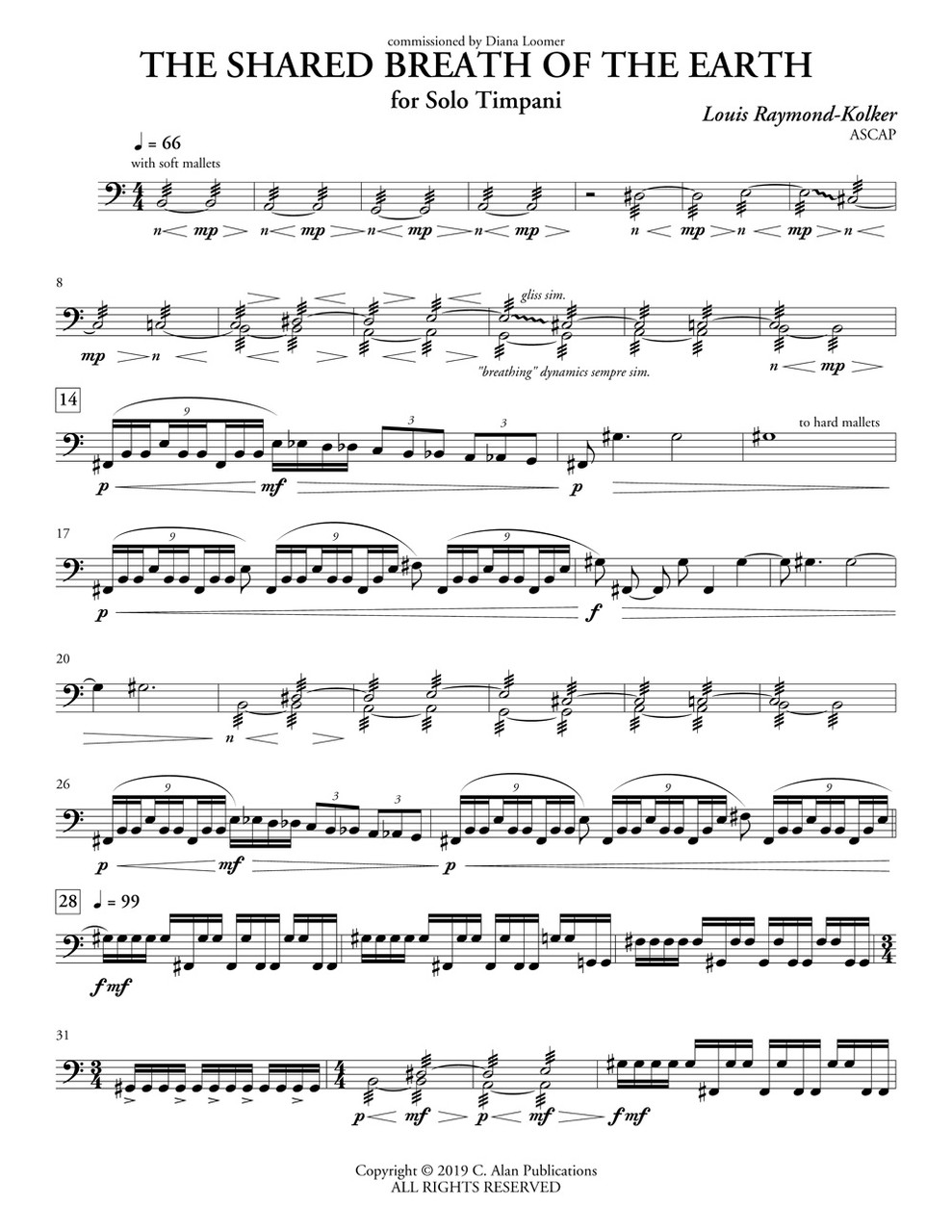
Program Notesthe shared breath of the earth is a solo for melodic timpani and a celebration of three characters of nature that live in urban settings. The primary character is between the two middle timpani and represents the exchange of carbon dioxide and oxygen as plants and animals respirate. The second character comes from a particularly striking memory of mine walking through a parking lot to get to school and seeing wind pick leaves up in a spiral before gently dropping them. This is represented with swirling nontuplets that climb up the drums before gently descending chromatically. Finally, underneath everything else, pieces of the earth shift against one another their rumbling and roaring embodied in the tumultuous outer drums. These three characters combine and interact with one another, as they work to find a balance within themselves and each other.
Diana Loomer commissioned the shared breath of the earth for The Melodic Timpani Project and premiered the work on March 10, 2018.
-
Video
-
The Melodic Timpani Project: the shared breath of the earth by Louis Raymond-Kolker
Diana Loomer DMA 2 Recital The University of Texas at Austin March 10, 2018, 1:30 PM Bates Recital Hall
-
-
Product Reviews
-
Percussive Notes New Literature Review
This publication approaches timpani performance quite differently than the norm, as it is composed for a set of four drums, scored in a melodic fashion. This is accomplished by having the two outside instruments tuned to low F-sharp and high G-sharp. The two middle drums handle the many note changes via pedal movements. Some note changes have glissando notation, but all of the other note changes must be made by quick movement, so that the notes are clean and not “glissed.”
The solo opens with half-note rolls, which change expression via crescendo and decrescendo notation. This introduction section concludes with a fanfare-type ending and a change to hard mallets. The expression and technical figures include rapid sixteenth notes with accents, sextuplets, and nine-tuplets, which are played over quarter-notes. There are numerous pitch changes, so the challenge includes rhythmic maturity, but also much ear-training to execute the melodic material correctly. The solo concludes with a return to the rolls and a change back to softer mallets. This is a very challenging and impressive piece. It will require some serious time at the piano or keyboard to learn the many pitch changes required. I hope many timpanists will want to take on the challenge.
George Frock
PERCUSSIVE NOTES
VO. 59, NO. 2, APRIL 2021 George Frock on Jun 29th 2022
-