- New!
- Band
- Percussion
- Orchestra
- Brass Band
- Jazz
- Chamber
- Voice






Through an Open Door (Band Gr. 4.5)
Genre: Band
Series: Diamond Band Series
# of Players: Standard
Level: 4.5 | Duration: 7:15
Publisher: C. Alan Publications | Copyright: 2023
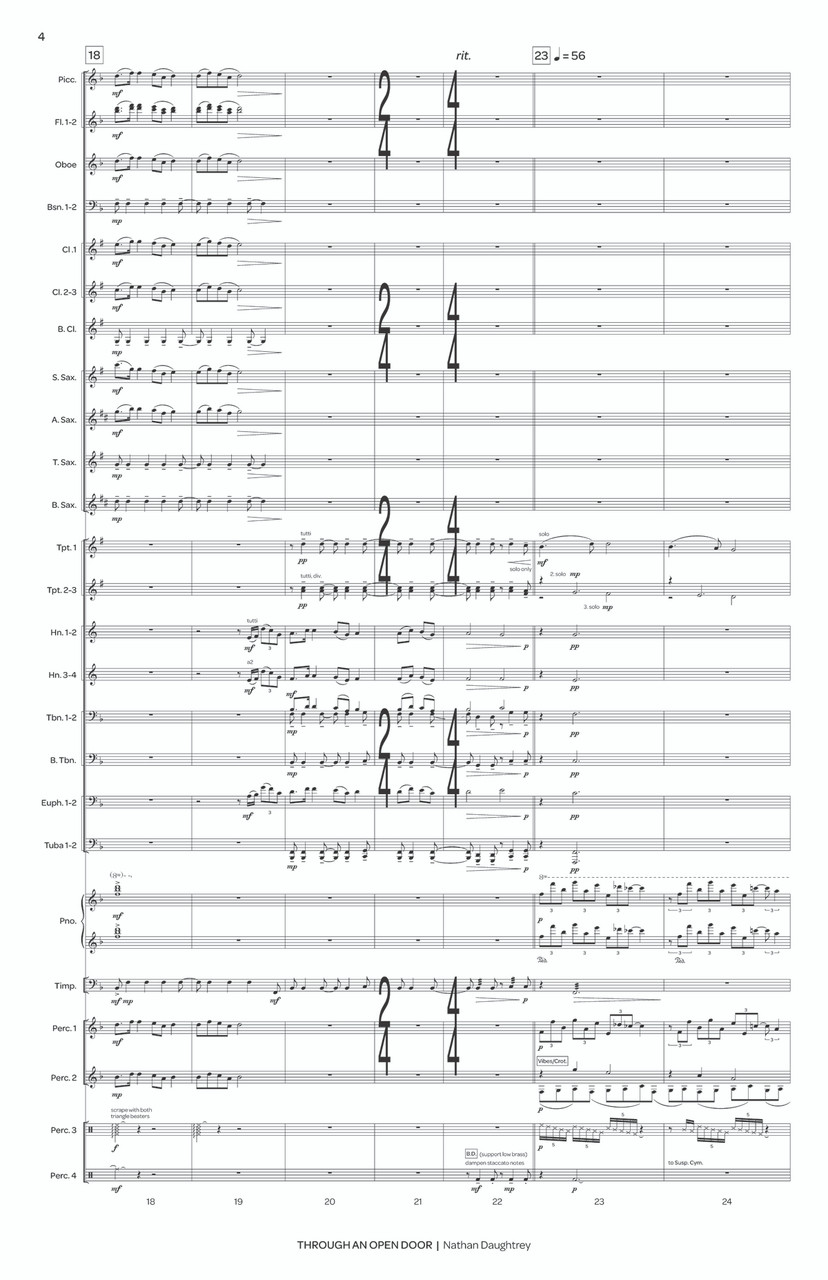
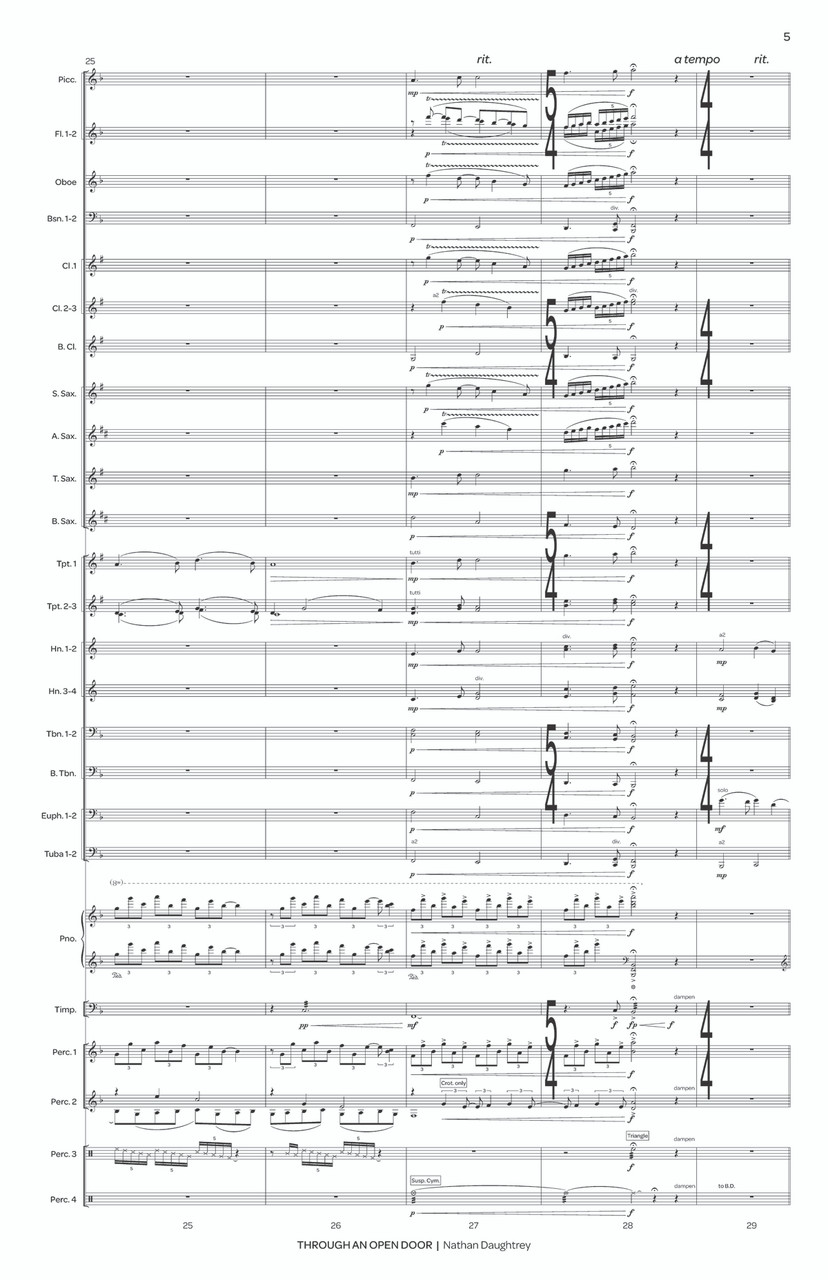
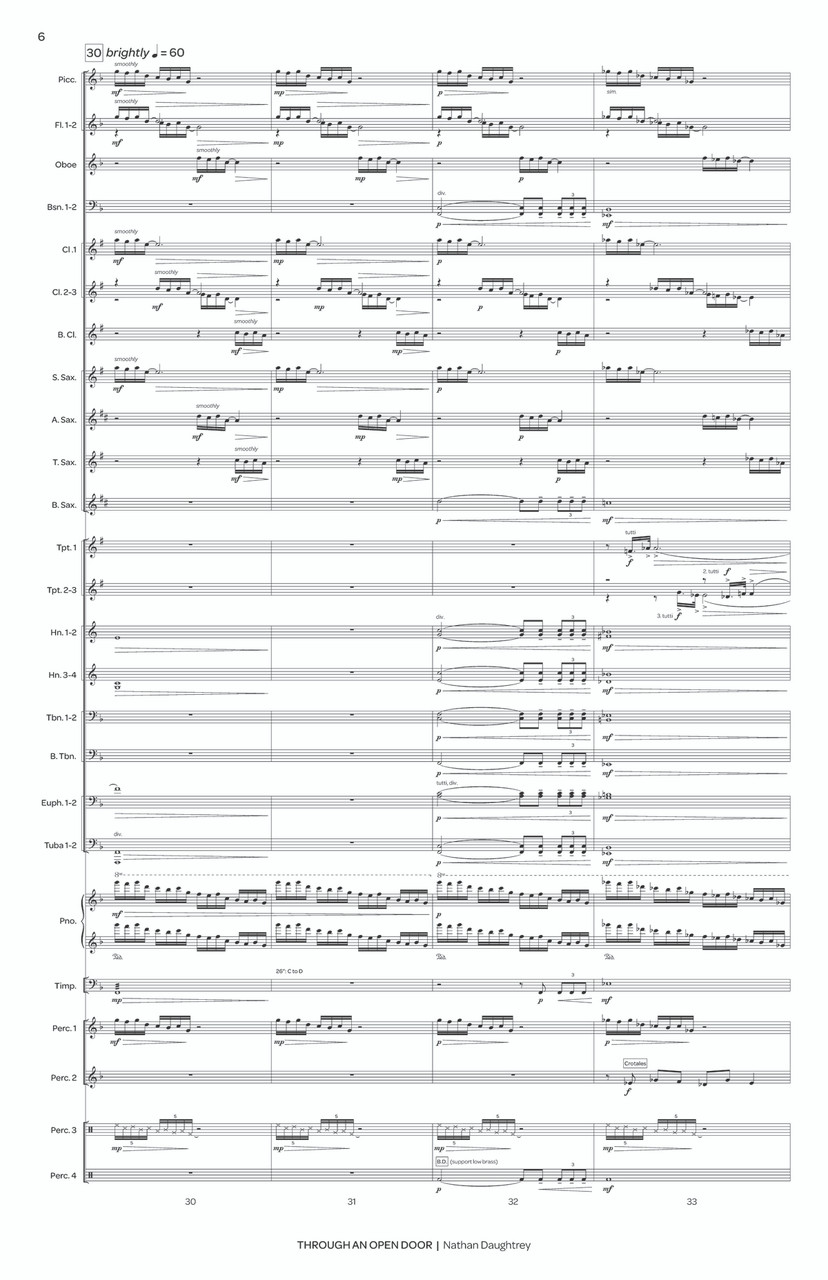
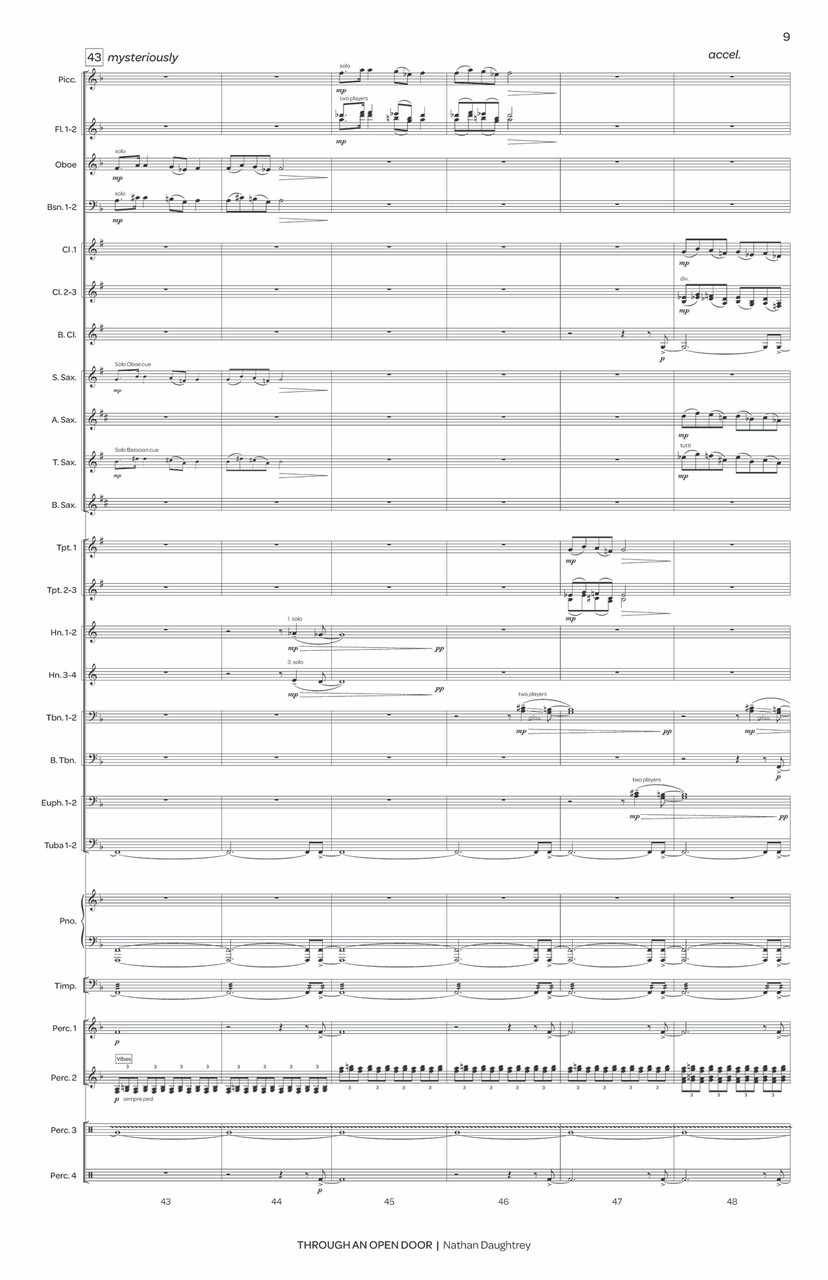
Download mp3 | Click on images to left for score sample
Price:
$120.00
Item #:
31320
-
Notes & Instrumentation
Celebrating the legacy of Marcellus Brown’s tenure as director of bands at Boise State University, Through an Open Door is a lush setting of the spiritual Goin’ Home (Dvorák) that cleverly marries the chromatic spelling of “MARCELLUS” with the original spiritual. The arrangement stays true to the original while adding new countermelodies, re-harmonization, and fresh colors and textures.
Genre: Band | # of Players: Standard
Series: Diamond Band Series
Level: 4.5 | Duration: 7:15
Instrumentation
Piccolo
Flute 1
Flute 2
Oboe
Bassoon 1 & 2
B-flat Clarinet 1
B-flat Clarinet 2
B-flat Clarinet 3
B-flat Bass Clarinet
Soprano Saxophone
Alto Saxophone
Tenor Saxophone
Baritone Saxophone
B-flat Trumpet 1
B-flat Trumpet 2
B-flat Trumpet 3
F Horn 1
F Horn 2
F Horn 3
F Horn 4
Trombone 1
Trombone 2
Bass Trombone
Euphonium 1
(Baritone T.C. 1)
Euphonium 2
(Baritone T.C. 2)
Tuba 1
Tuba 2
Piano
Timpani [4 drums]
Percussion 1: Chimes {shared], Glockenspiel
Percussion 2: Vibraphone, Crotales [2 octaves], Chimes [shared]
Percussion 3: Ocean Drum [shared], Bell Tree, Triangle, Suspended Cymbal
Percussion 4: Suspended Cymbal, Concert Bass Drum, Ocean Drum [shared]
Program Notes
Commissioned by current and former members and friends of the Treasure Valley Concert Band in honor and commemoration of Marcellus B. Brown's retirement after 33 years at Boise State University, Through an Open Door is a lush setting of the spiritual Goin’ Home (or Dvorák's 'Largo' from his "New World Symphony") for wind band. I used one of my favorite compositional tools to indeterminately create new pitch material to weave into the arrangement – a serial/chromatic alphabet (A-0, B-1, C-2, etc.). MARCELLUS 0-0-5-2-4-11-11-8-6 F-F-Bb-G-A-E-E-Db-Cb Sometimes this technique doesn’t yield anything usable, but in this case, it resulted in something magical. First, most of the pitches are diatonic to F Major, which is the key I set the hymn. Second, the last two notes are well outside the key of F Major, creating a head-turning dissonance. The magical part is that these two odd notes that spark interest fall on the last two letters of his name, spelling the word “Us.” Successfully leading an ensemble is less about “me” (the conductor) and all about “us” (the ensemble). As such, this “Us” motive is found throughout the work (e.g. horn in m. 8-9, solo brass in mm. 44-50, saxes/horns/trombones in mm. 65-66, etc.), always creating a moment of tension and release. Approach this setting with warmth, sensitivity, and joyous celebration! – N.D. -
Product Reviews