- New!
- Band
- Percussion
- Orchestra
- Brass Band
- Jazz
- Chamber
- Voice



Magic (Perc Ens 8)
Genre: Percussion Ensemble
# of Players: 8
Level: Medium | Duration: 5:00
Publisher: C. Alan Publications | Copyright: 2020
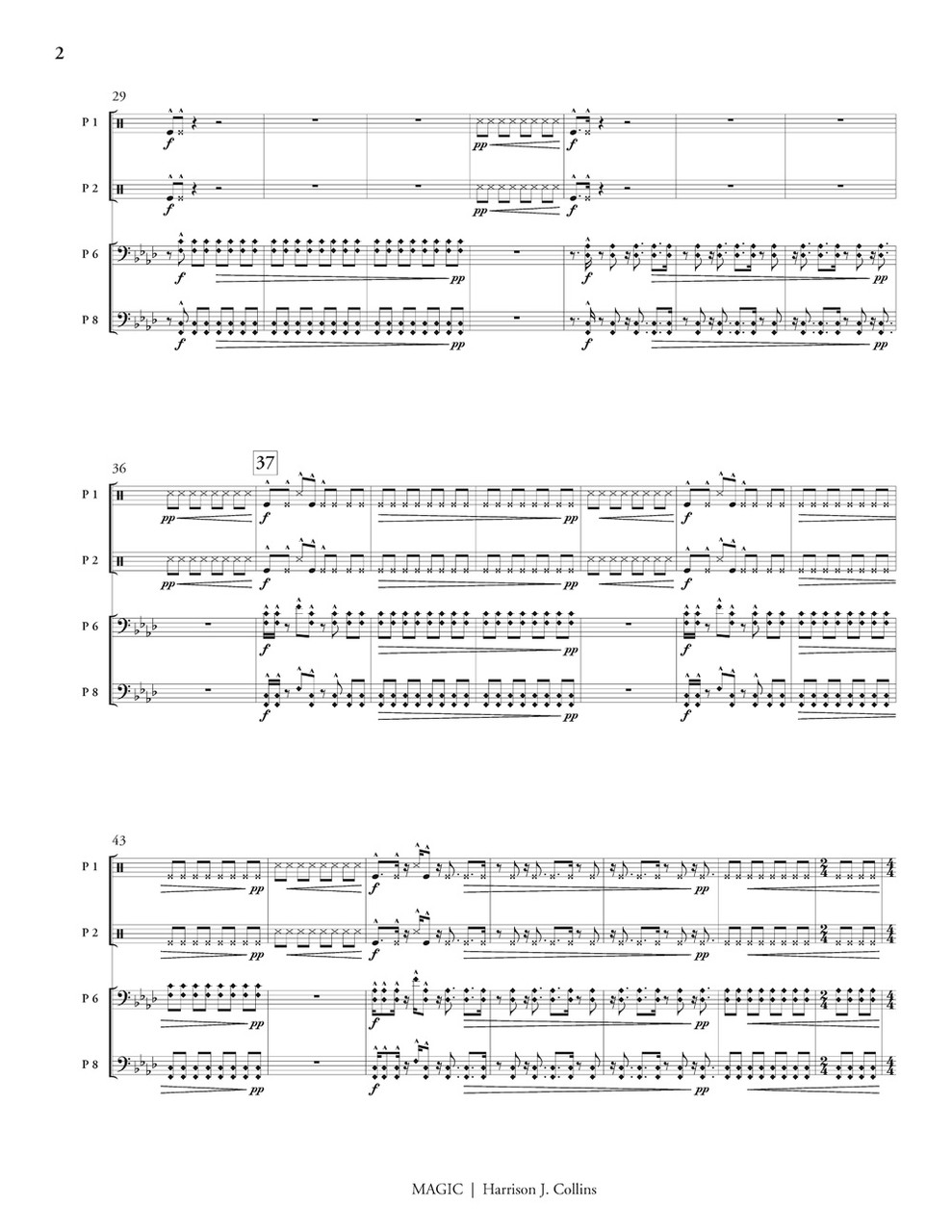
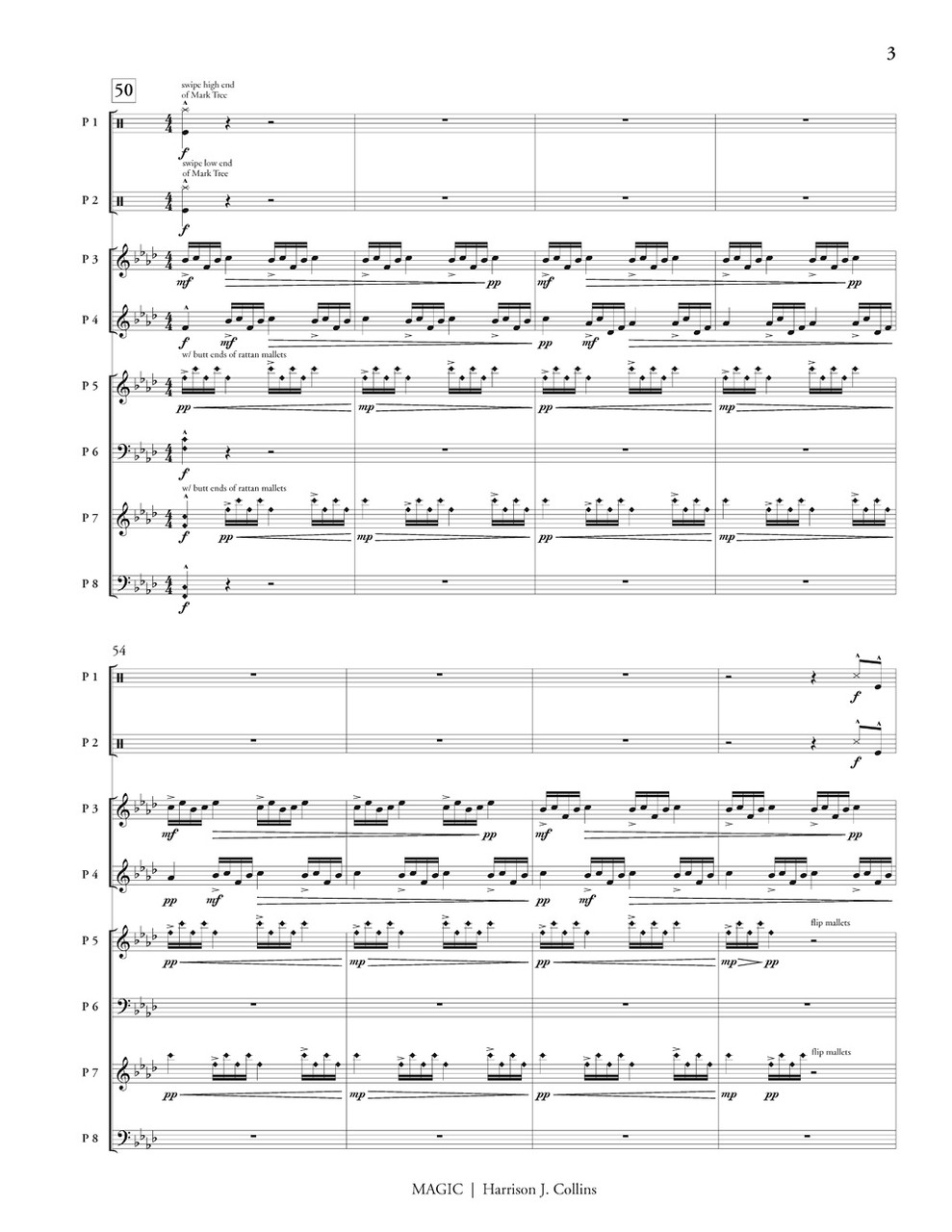
Download mp3 | Click on images to left for score sample

Rating:
Price:
$40.00
Item #:
27380
-
Notes & Instrumentation
With an incessantly dark, ritualistic quality coupled with a metallic sparkle, Magic takes its title from the concept of magic as a powerful and unknowable cosmic force, and the awe – and potentially fear – that may be felt in its presence.
Genre: Percussion Ensemble | # of Players: 8
Level: Medium | Duration: 5:00
Instrumentation
Player 1: Kick Drum + Mark Tree [shared w/ P 2]
Player 2: Kick Drum + Mark Tree [shared w/ P 1]
Player 3: Glockenspiel
Player 4: Glockenspiel
Player 5: Marimba [4-octave]*
Player 6: Marimba [4-octave]*
Player 7: Marimba [5-octave]*
Player 8: Marimba [5-octave]*
*Players 5 and 6 may share one 4-octave instrument and Players 7 and 8 may share one 5-octave instrument
Program Notes
Magic is a product of my deep interest and appreciation for modern percussion music. The work is somewhat minimalist in nature, and carries with it an incessantly dark, ritualistic quality coupled with a metallic sparkle. Although not programmatic in nature, Magic takes its title from the concept of magic as a powerful and unknowable cosmic force, and the awe – and potentially fear – that may be felt in its presence.
-H.J.C -
Product Reviews
-
Percussive Notes New Literature Review
This 5-minute work for percussion ensemble is effective in communicating several different moods and characters while only utilizing a few instruments and a limited rhythmic palette. The opening section is quite bombastic and “ritualistic” as it moves the music forward with repeated eighth notes on a shared kick drum, which are interrupted from time to time with syncopated rim clicks. When the keyboard notes enter, they initially match the regimented rhythmic nature of the beginning while eventually morphing into overlapping sixteenth-note flourishes. After a good bit of activity and build in the musical narrative, the energy is quickly gathered up, and the piece finishes as it began.
Harmonically, the majority of the piece hovers around F minor and D minor, which eventually supports the folk-song-like melody in F minor. From a rhythmic perspective, the individual parts will not pose a challenge to players who are secure with sixteenth-note based rhythms with slight deviations into offbeat syncopations. When the music does drift towards heavy rhythmic activity, the composer brings the music back to the opening eighth-note foundation — sort of a rhythmic tonic to ground the energy.
While the piece is not programmatic, the all-encompassing title is vague enough to allow individual listeners to “fill in the gaps” of the musical story during a performance. Overall, this work is thoughtful and captivating, and will have enough appeal to students, directors, and audience members to make a lasting impression.
Joshua D. Smith
Percussive Notes
Vol. 59, No. 5, October 2021 Joshua D. Smith on Jun 30th 2022
-