
- New!
- Band
- Percussion
- Orchestra
- Brass Band
- Jazz
- Chamber
- Voice


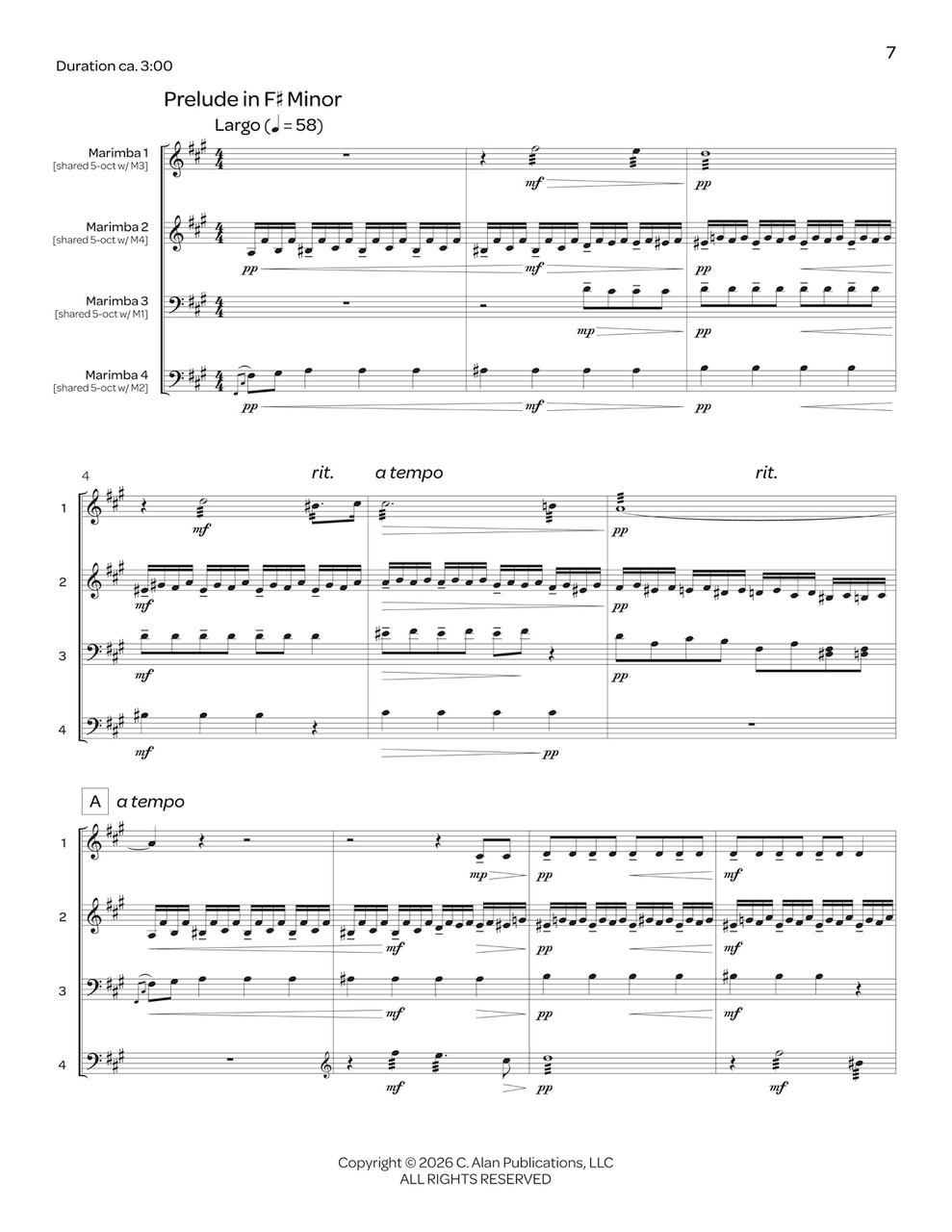
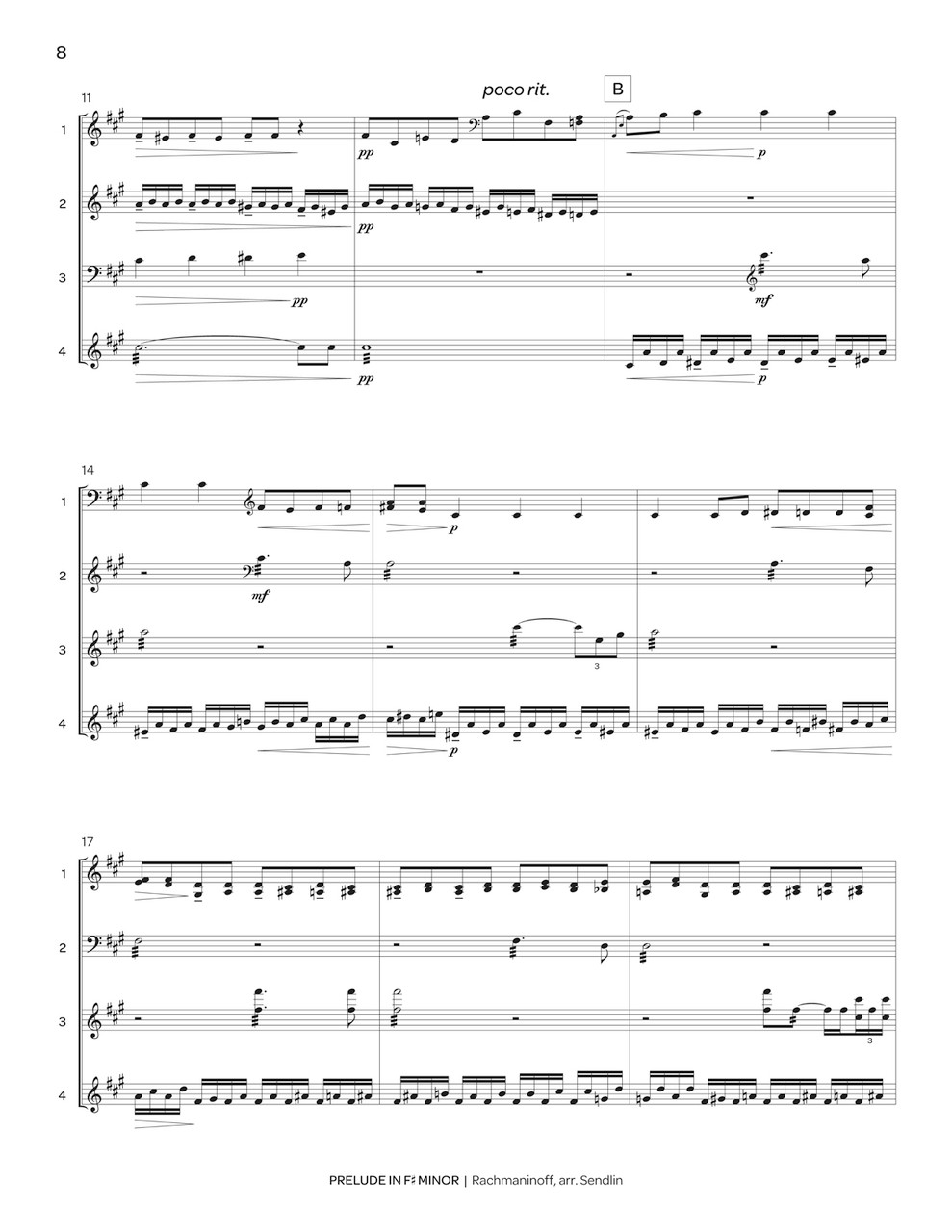
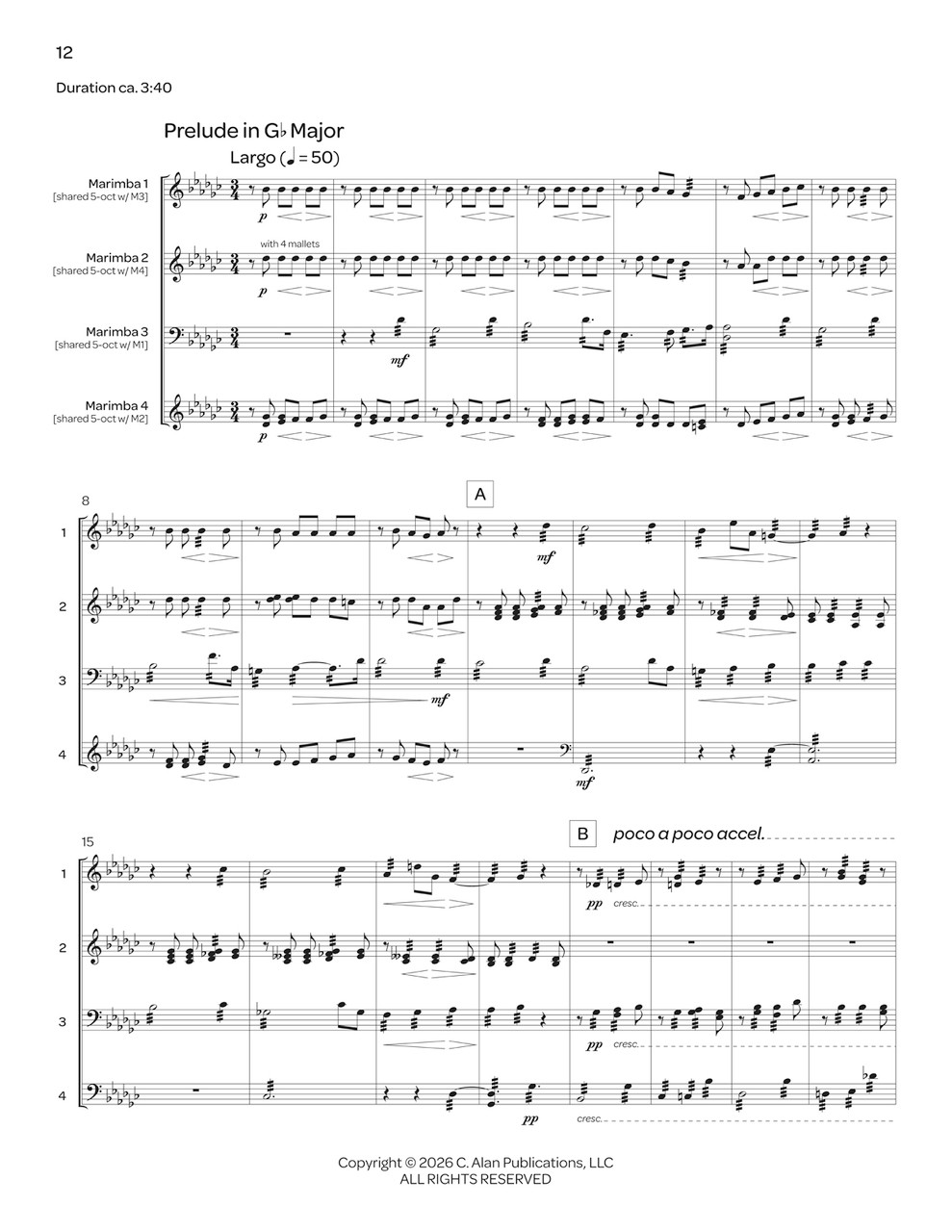
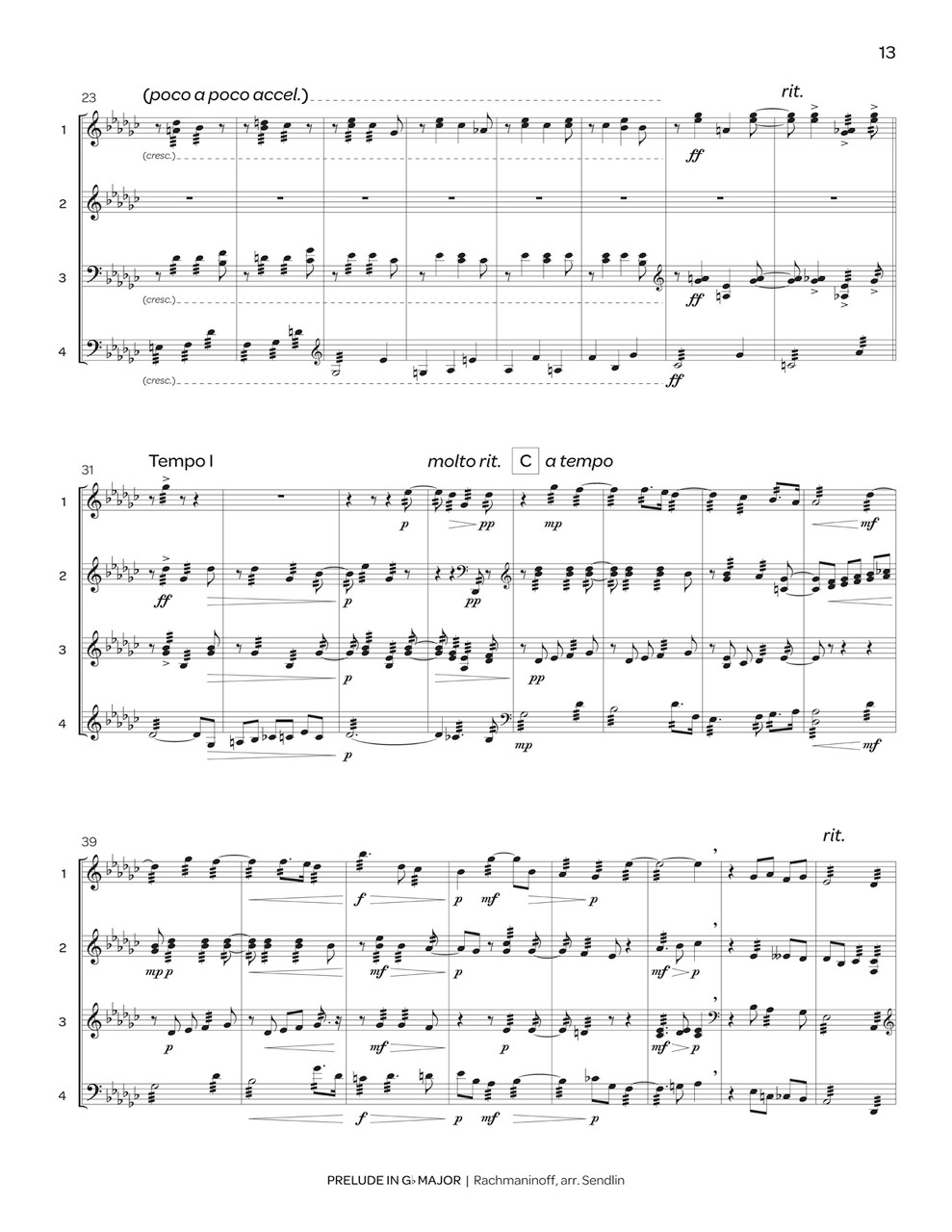
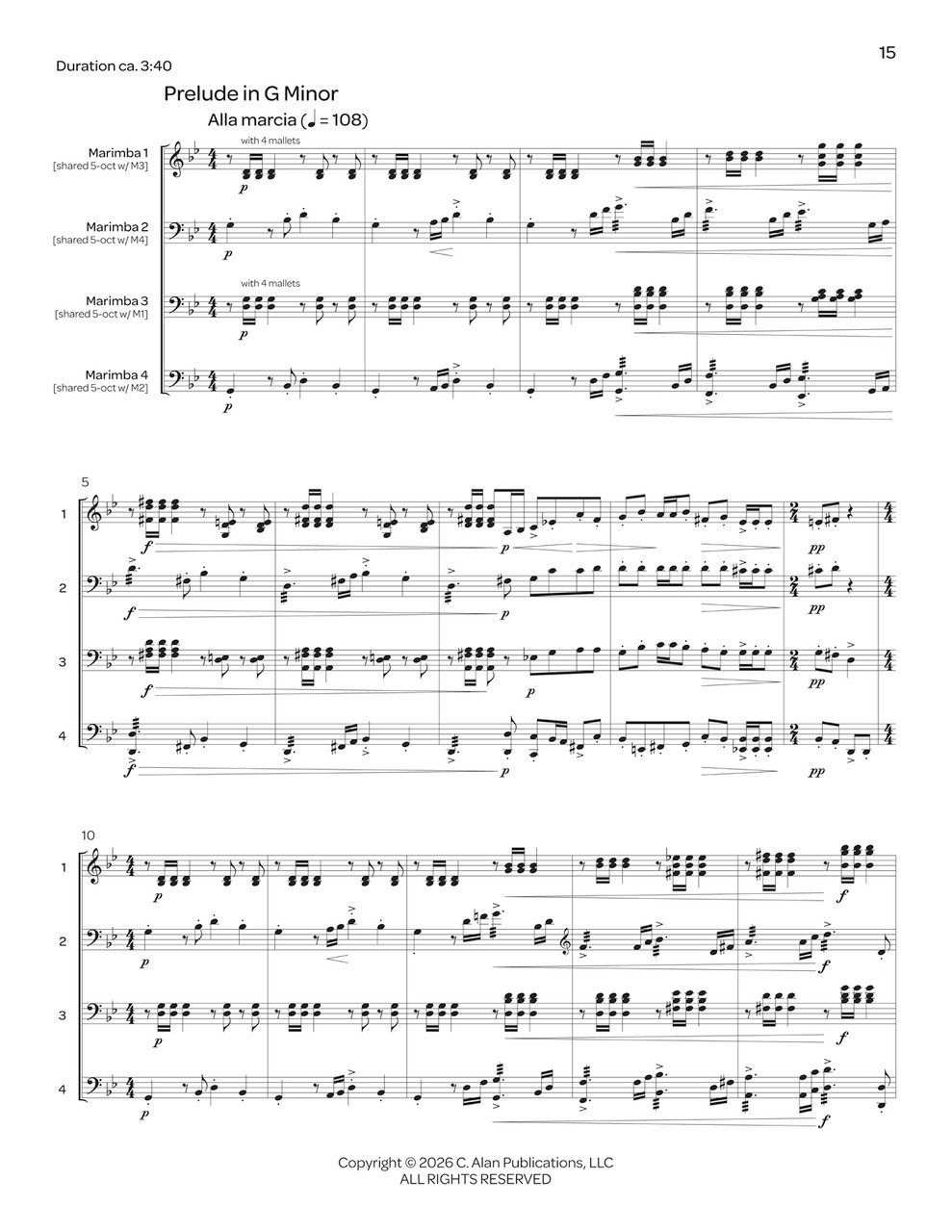
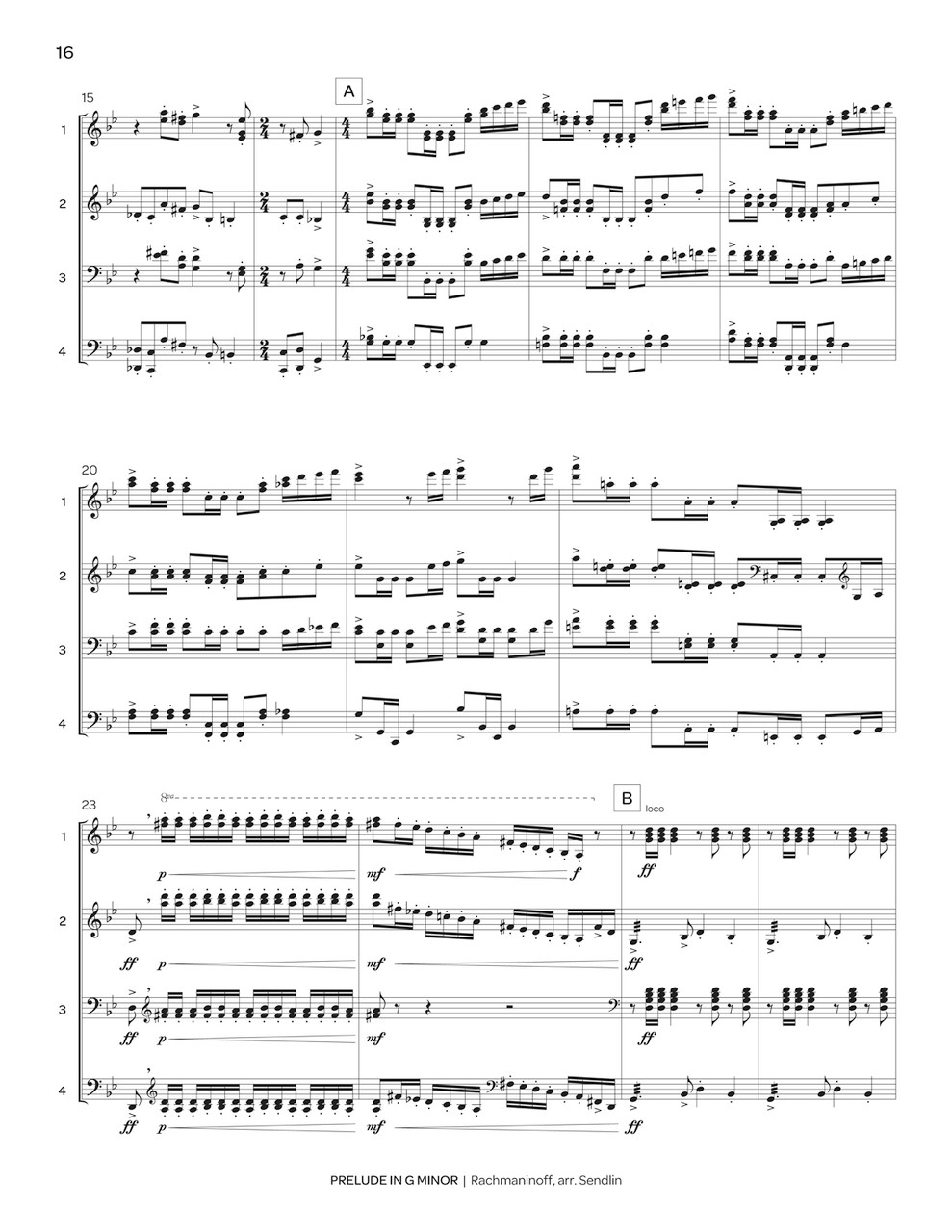
Four Rachmaninoff Preludes (4 Players on 2 Marimbas)
Genre: Percussion Ensemble
# of Players: 4
Level: Medium Advanced | Duration: 14:30 total
Publisher: C. Alan Publications | Copyright: 2026

Price:
$48.00
Item #:
36980
-
Notes & Instrumentation
Arranged for 4 players on two 5-octave marimbas, the selected preludes in this collection are drawn from Rachmaninoff’s 10 Preludes, Op. 23. Rachmaninoff was one of the last notable composers of the Romantic era, bridging the ending of Romanticism and the beginnings of Modern/20th Century music. This can be seen with the combination of popular Romantic principles (expression, emotion, and chromaticism) with the freedom and deviation from standard Western Tonal principles that 20th Century music began to explore. This, combined with his use of weight and other emphases on articulation, provides a worthy challenge to four mallet players attempting to combine their sounds to recreate the effectiveness of Rachmaninoff’s mighty hands on the piano.
Genre: Percussion Ensemble | # of Players: 4
Level: Medium Advanced | Duration: 14:30 total
Instrumentation
Score (8.5"x11" stapled booklet)
Marimba 1: 5-octave*
Marimba 2: 5-octave*
Marimba 3: 5-octave*
Marimba 4: 5-octave*
*Only two 5-octave marimbas, shared between Players 1 & 3 and 2 & 4 are required for performance.
Program Notes
Arranged for 4 players on two 5-octave marimbas, the selected preludes in this collection are drawn from Rachmaninoff’s 10 Preludes, Op. 23. Rachmaninoff was one of the last notable composers of the Romantic era, bridging the ending of Romanticism and the beginnings of Modern/20th Century music. This can be seen with the combination of popular Romantic principles (expression, emotion, and chromaticism) with the freedom and deviation from standard Western Tonal principles that 20th Century music began to explore. This, combined with his use of weight and other emphases on articulation, provides a worthy challenge to four mallet players attempting to combine their sounds to recreate the effectiveness of Rachmaninoff’s mighty hands on the piano.Prelude in D minor
This beginning prelude draws heavy inspiration from older Baroque and Classical-Era styles, and displays Rachmaninoff’s (at the time) “modern-day” approach to them. The “A” section of this prelude is to be played like a Minuet, a light, dance-like, triple-meter piece that was popularized in France in the 17th and 18th Century. A majority of this section is played with staccato articulation, allowing for the piece to appear separated and bounding. The “B” section of this piece draws from fugal elements popularized by Bach, featuring overlapping contrapuntal melodies and harmonies that are repeated and reinterpreted between restatements. Tenuto articulations are more prevalent in this section, emphasizing length, further creating a juxtaposition between the two styles. He combined these two styles while adding his own voice allowing this opening prelude to be an exceptional introduction to this larger work showcasing the world of Rachmaninoff.Prelude in F-sharp Minor
This prelude wonderfully highlights Rachmaninoff’s Romantic-style composition. Rachmaninoff suffered from Depression in the turn of the 20th century and late into his life. His deep, profound emotion can be heard in many, if not all of his works, but especially in this prelude. A slow, beautifully aching melody is played over a continually wading chromatic harmony. These combining elements are what draw so much emotion out of both the listener and the performer. Rachmaninoff additionally explores the use of melodic range in this prelude, with the middle section introducing melodic figures on the low end of the register, adding yet more emotional depth to this already gut-wrenching work.Prelude in G-flat Major
This prelude displays similar Romantic-Era compositional traits as the previous prelude but evokes a different emotional response. While this prelude also features a slow, connected melody supported by chromatic harmonic figures, it is set in a major key. This strangely replaces the longing and sadness of the previous prelude with a more yearning nostalgic feeling. Another element that aids to this emotional output is that a majority of this prelude sits in the mid-to-upper range of the register. The main melodic material, unlike the previous prelude, is played in the heart of the midrange, as the accompaniment is played over the melody in the upper register. This allows for introductions of the low range of the register, which only happens a few times in this prelude, to be a very effective timbral change. The prelude’s concluding section features sweeping arpeggiations in a two-against-three feel, providing a brief discombobulation before returning the listener back to Rachmaninoff’s beautiful opening theme.Prelude in G Minor
This final prelude is perhaps the most recognizable of Rachmaninoff’s preludes. Primary figures throughout the “A” section are played as a call and response between octaves , while the “B” section features appreciating sextuplets supporting a repeating melodic passage on top. A wide register and a thick texture is utilized throughout a majority of this prelude. This combined with Rachmaninoff’s use of weight makes this piece a fierce tour de force and an appropriate end to this work. -
Product Reviews
![La Fille aux Cheveux de Lin (Mallet Trio) [Debussy]](https://cdn10.bigcommerce.com/s-uhegu0/products/6102/images/57226/La_Fille_Aux_Cheveux_De_Lin__06602.1721146946.200.200.png?c=2)
![Passepied (Perc Ens 6) [Debussy]](https://cdn10.bigcommerce.com/s-uhegu0/products/6185/images/58181/Passepied__19134.1724099523.200.200.png?c=2)

