- New!
- Band
- Percussion
- Orchestra
- Brass Band
- Jazz
- Chamber
- Voice
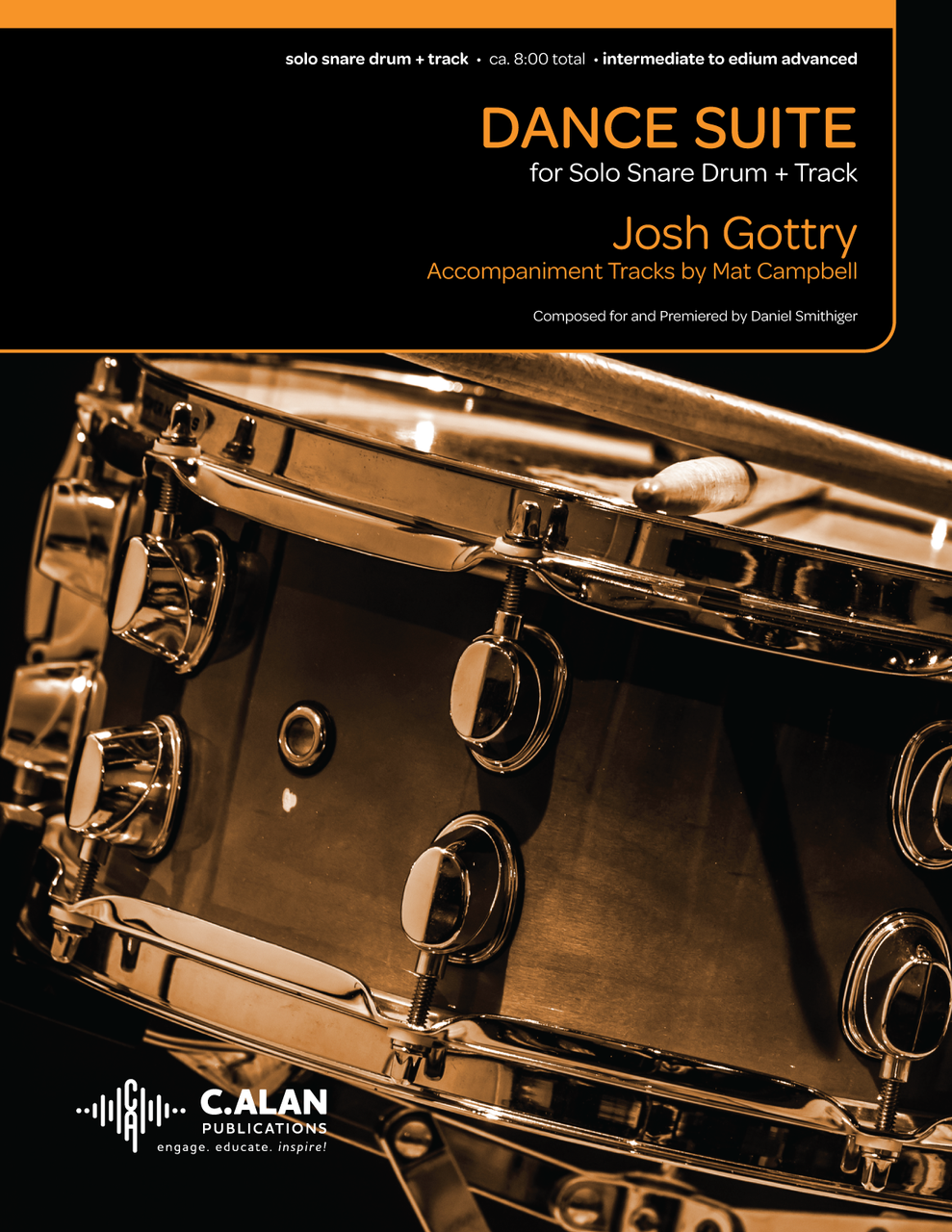


Dance Suite (Snare Drum + Track)
Genre: Snare Drum + Track
# of Players: 1
Level: Intermediate to Medium Advanced | Duration: 8:00 total
Publisher: C. Alan Publications | Copyright: 2026
DOWNLOAD PRACTICE + PERFORMANCE TRACKS

Price:
$18.00
Item #:
36860
-
Notes & Instrumentation
Dance Suite for solo snare drum is composed in four movements, each representing one of the four standard baroque dances: Allemande, Courante, Sarabande, and Gigue. Each movement is approximately 90 seconds to two minutes in length and can be performed individually, collectively with one or two of the other movements, or as the full suite of four dances. Subtle references to a notable snare drum excerpt are woven into each movement, and fixed-media play-along tracks based on dance movement compositions by J.S. Bach.
Genre: Snare Drum + Track | # of Players: 1
Level: Intermediate to Medium Advanced | Duration: 8:00 total
Instrumentation
Snare Drum
Fixed Electronic TrackDOWNLOAD PRACTICE + PERFORMANCE TRACKS
Program Notes
Dance Suite for solo snare drum is composed in four movements, each representing one of the four standard baroque dances: Allemande, Courante, Sarabande, and Gigue. Each movement is approximately 90 seconds to two minutes in length and can be performed individually, collectively with one or two of the other movements, or as the full suite of four dances. Subtle references to a notable snare drum excerpt are woven into each movement, and fixed-media play-along tracks based on dance movement compositions by J.S. Bach are supplied at three tempos for performance along with two practice tempo tracks with click.I. STATELY with “Allemande” from Partita No. 1 in B-flat major, BWV 825 by J.S. Bach
Set at a moderate tempo and littered with a variety of grace-note figures, this movement exudes a majestic character and should be played with exceptional attention given to clarity. This movement is notated on a single line, so performers should use their discretion to select the most appropriate playing spots on the head for each note or phrase. Woven into this solo are references to “Birth of Kijé” from Lieutenant Kijé Suite, Op. 60 by Prokofiev.II. un-SNARED with “Courante” from Partita No. 2 in D minor, BWV 1004 by J.S. Bach
Set in a fast three and exploring multiple playing spots with the snares off, energy and precise placement of the sticks are paramount to the character of this movement. Performers should strive for a dry sound at, or very near, the center of the head contrasting with a resonant sound within an inch of the edge of the drum. A fluid vertical stroke should be unimpacted by the movement between playing positions and the frequent alternations between duple- and triple-based figures. Woven into this solo are references to the second movement of Bartók’s Concerto for Orchestra.III. SONANCE with “Sarabande” from Partita No. 2 in C minor, BWV 826 by J.S. Bach
Notably the slowest movement but one that contains the greatest array of sounds, this movement relies on the players ability to move between playing spots and execute numerous different divisions of the beat. If played well, the performance should be fluid, relaxed, and lyrical. Woven into this solo are adapted fragments of the snare drum part from just prior to the cadenza in Nielsen’s Concerto for Clarinet and Orchestra, op. 57.IV. SHIFTY with “Gigue” from Partita No. 2 in D minor, BWV 1004 by J.S. Bach
Set in a moderate two and the only compound meter dance in the collection, this movement requires the performer to maintain a pervasive division in three while navigating multiple playing spots, various rhythmic subdivisions, and a full dynamic spectrum. Woven into this solo is the shuffle rhythm that is a distinctive component of the “Polovetsian Dances” from Prince Igor by Borodin. -
Product Reviews